

In-Ground, Portable, or Wall-Mount: Which Basketball Hoop Is Right for Your Driveway?
Omaha Sports & Games
The first decision you make when buying a basketball hoop determines almost everything that follows: your budget, how the hoop performs, where you can put it, and whether it's still standing after a Nebraska thunderstorm. That decision is in-ground, portable, or wall-mount. Get it right and your driveway becomes the neighborhood court. Get it wrong and you're looking at a wobbly pole, a cracked base, or a two-day concrete project you weren't counting on.
This guide breaks down all three options — in-ground, portable, and wall-mount — plus backboard sizing, backboard materials, and the Goalsetter vs. Goalrilla debate, so you can buy with confidence.
In-Ground vs. Portable vs. Wall-Mount: Pros and Cons
In-ground hoops
In-ground hoops are cemented directly into the ground, giving them the rigidity and stability that serious players need. The pole doesn't shift when the ball hits the backboard. The rim doesn't rattle on a layup. If you want a hoop that feels like the ones at the downtown YMCA, this is the path.
Pros: maximum stability, regulation feel, best rebound quality, highest resale value, adjustable height on most models.
Cons: requires concrete installation, permanent (though bolt-down systems can be removed), higher price point.
Most in-ground systems use one of two mounting methods:
- Anchor plate (bolt-down): A steel sleeve is set in concrete, and the pole bolts on top. If you move, you unbolt the hoop and reattach it at your new house with a new anchor kit. Goalsetter uses this system on every in-ground model they make.
- Direct burial: The pole itself goes into the concrete. Simpler, but permanent. You can't remove it without digging it out.
Key takeaway: Bolt-down anchor systems let you take your hoop with you when you move. Direct burial doesn't. If you might relocate, choose bolt-down.

Premium pick
Goalsetter MVP 72" In Ground Basketball Hoop
$2,999.00 $3,099.00
72-inch tempered glass backboard, adjustable 6' to 10', bolt-down anchor system. The closest thing to a college arena in your driveway.
View productPortable hoops
Portable hoops have a base you fill with sand or water, and they can be wheeled to different spots. No concrete, no digging, no waiting.
Pros: no installation, movable, no concrete or digging required, works for renters.
Cons: less stable (the base shifts on aggressive play), can tip in high wind, bulkier footprint, limited backboard quality at lower price points.
Fill the base with sand, not water. Sand is denser, won't freeze and crack the plastic base during a Nebraska winter, and doesn't evaporate. A 35-gallon base filled with dry sand weighs nearly 500 pounds, enough for casual shooting. Still not as solid as an in-ground system, but far better than water.


Portable pick
RollaSport III 54" Acrylic Portable Basketball Hoop
$2,907.00
54-inch acrylic backboard, wheeled base for easy transport, heavy-duty construction. A premium portable hoop that goes where you need it — no concrete required.
View productWall-mount hoops
If your driveway is tight or you have a garage facing the play area, a wall-mount hoop bolts directly to the structure. No pole, no base, no ground space. You'll need a solid masonry wall or reinforced framing — siding and studs alone won't hold up. Wall-mount hoops work well for small spaces and can be mounted at a fixed height or with an adjustable arm. They're the least common choice but the right one for homes where a freestanding pole isn't practical.
Pros: zero ground footprint, no pole or base in the driveway, solid stability when properly mounted, adjustable height on some models.
Cons: requires a structurally sound wall (masonry or reinforced framing), permanent installation, not movable, limited to where you have a suitable mounting surface.


Wall-mount pick
RoofMaster Endura Roof or Wall Mount Basketball Hoop
$3,341.00
60-inch aluminum backboard, adjustable from 6.5' to 10' with ground-level crank handle. Mounts to any roof pitch or vertical wall. No pole, no ground space needed.
View productWhat Size Backboard Do I Need for My Driveway?
Backboard size matters more than most buyers expect. A bigger backboard means more room for bank shots, better rebound off missed attempts, and a more game-like feel. But it also means more weight, more cost, and a wider footprint that may overwhelm a narrow driveway.
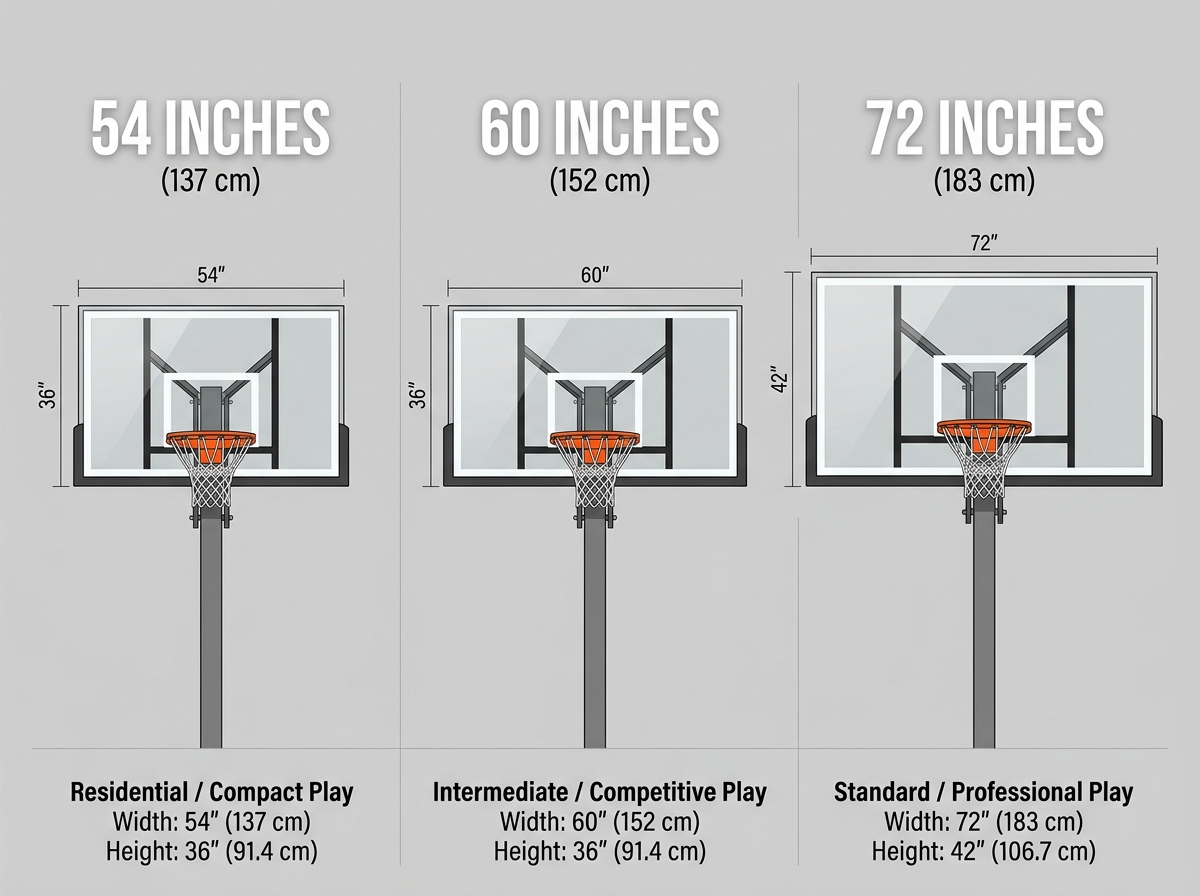
| Backboard width | Best for | Driveway type |
|---|---|---|
| 54" | Casual play, kids, beginners | 1-car driveway |
| 60" | Family use, teens, competitive shooting | 1.5 to 2-car driveway |
| 72" | Regulation play, serious players, team practice | 2+ car driveway |
Regulation high school and NCAA backboards are 72 inches wide. If your kid plays competitive basketball, a 72" backboard at home means practice transfers directly to game conditions. For most families, 54" or 60" hits the sweet spot: big enough for real play, compact enough for a standard residential driveway.

Goalsetter Captain 60" In Ground Basketball Hoop
$2,399.00
60-inch backboard, ideal for 2-car driveways and family play.
View product
Goalsetter All-Star 54" In Ground Basketball Hoop
$2,499.99
54-inch backboard, the entry-level in-ground for 1-car driveways.
View productTempered Glass vs. Acrylic vs. Polycarbonate Backboards
The backboard material affects rebound quality, durability, and price. Here's how the three options stack up:
- Tempered glass: The gold standard. Used in college and NBA arenas. Gives the truest rebound, the ball comes off the glass cleanly and consistently. Heaviest, most expensive, and can shatter on extreme impact (rare but possible). Best for serious players who want game-like performance.
- Acrylic: A clear plastic that looks like glass but is lighter and less expensive. Good rebound, though slightly more "dead" off the board than tempered glass. Won't shatter. The most popular choice for home in-ground systems. It hits the performance-to-price sweet spot for most families.
- Polycarbonate: The most affordable and most durable plastic option. Nearly unbreakable. But the rebound is noticeably softer and less consistent. Best for young kids and casual backyard play where budget and durability matter more than performance.
If you're investing in an in-ground system, go with tempered glass or acrylic. Polycarbonate is fine for portable hoops where the base stability, not the backboard, is the limiting factor.

Budget in-ground pick
Goalsetter Extreme Series 54" In Ground Basketball Hoop
$1,899.99
54-inch backboard with adjustable height and bolt-down anchor. The most affordable way to get a permanent in-ground system from a top brand.
View productGoalsetter vs. Goalrilla: Which Brand Is Better?
Goalsetter and Goalrilla are the two biggest names in premium in-ground basketball hoops, and buyers compare them constantly. Both make excellent products. Here's an honest breakdown.
Goalsetter (carried at Omaha Sports & Games):
- Made in the USA (Ames, Iowa)
- Adjustable height from 6' to 10' on most models, lower minimum than most competitors, which matters if you have young kids
- Anchor plate bolt-down system on all in-ground models, removable if you move
- Off-set pole design that reduces stress on the system during aggressive play
- Lifetime warranty on all parts
Goalrilla:
- Also USA-made (Gordonville, Missouri)
- Typically adjusts from 7.5' to 10', higher minimum, less ideal for small children
- Uses a direct-bury or anchor system depending on the model
- Heavier pole construction, which some players prefer for rigidity
- Limited lifetime warranty
The real difference comes down to adjustability range and mounting system. Goalsetter's 6' minimum height makes it the better choice for families with young kids, and the bolt-down anchor means you can take it with you if you sell your house. Goalrilla's heavier pole appeals to players who want maximum rigidity for aggressive, competitive play.
Both are excellent. We carry Goalsetter because the lower height range and bolt-down system make it more versatile for the families we serve in Omaha and across the country.
In-Ground Basketball Hoop Installation: What to Expect
Installing an in-ground hoop is a weekend project if you're handy, or a few hundred dollars if you hire it out.
What's involved:
- Dig a hole, typically 24" to 36" deep and 18" to 24" wide, depending on the system
- Set the anchor sleeve (for bolt-down systems) or pole base in the hole
- Pour concrete, usually 6 to 10 bags of 80-lb concrete mix
- Let it cure 24 to 48 hours before attaching the hoop
- Assemble the pole, backboard, and rim, then bolt everything to the anchor
Typical cost:
- DIY: $50 to $100 in concrete and gravel, plus your time
- Professional installation: $300 to $600 depending on your location and the system
In the Omaha area, professional installation runs on the lower end of that range. If you're pouring a new driveway or doing concrete work anyway, have the anchor sleeve set during the pour. It's cleaner and stronger than retrofitting into an existing slab.
All Goalsetter in-ground hoops from Omaha Sports & Games ship with the anchor kit and full installation instructions. Free shipping applies to the contiguous United States.
Basketball Hoop Buying Guide: Frequently Asked Questions
Can you dunk on a portable basketball hoop?
Not safely. Portable hoops aren't designed to handle the force of a dunk. The base can shift or tip, and the rim may bend. If dunking is part of your game, you need an in-ground system with a breakaway rim rated for dunking.
Can you move an in-ground basketball hoop if you sell your house?
Yes, if it uses a bolt-down anchor system like Goalsetter's. You unbolt the pole from the anchor sleeve, remove the hoop, and install a new anchor kit at your new home. Direct-burial systems can't be removed without digging out the concrete.
How much concrete do you need for an in-ground basketball hoop?
Most systems require 6 to 10 bags of 80-pound concrete mix, filling a hole roughly 24 to 36 inches deep. Check your specific model's instructions. The exact amount depends on the pole diameter and anchor system.
How low should an adjustable basketball hoop go for kids?
6 feet is the ideal minimum for young children (ages 5 to 8). Most portable and wall-mount hoops only go down to 7.5 feet, which is too high for small kids to shoot comfortably. Goalsetter in-ground models adjust from 6' to 10', making them the best option for families with children.
What overhang do you need for a driveway basketball hoop?
Aim for 2 to 4 feet of overhang, the distance from the pole to the backboard. This gives players room to drive the lane without running into the pole. Most in-ground systems have a fixed overhang of about 2.5 to 3 feet. For driveway play, 2 feet is the minimum safe distance.
Find Your Basketball Hoop at Omaha Sports & Games
Whether you're building a home court for a future college player or just want something the whole family can enjoy, the right hoop makes all the difference. Omaha Sports & Games carries a full line of Goalsetter in-ground basketball hoops with free shipping, factory-direct pricing, and expert advice from our team in Omaha and Elkhorn, Nebraska.
Stop by our showroom to see the hoops in person, or browse the full collection online.
Shop all basketball hoops