


In-Ground Trampolines: The Complete Buyer's Guide for 2026
Omaha Sports & Games
In-ground trampolines are quietly taking over Omaha backyards, and it's not hard to see why. They sit flush with the grass — no ladder, no cage-like frame towering over your landscape, no fall from three feet up. A trampoline that disappears into your lawn turns a backyard eyesore into a landscape feature, and that shift is driving the biggest change in residential trampolines in a decade.
This guide covers everything you need to decide: in-ground vs. above-ground, round vs. rectangular, sizing from 8ft to 17ft, the Berg vs. Capital Play brand question, installation expectations for Nebraska soil and weather, and what safety features actually matter. By the end, you'll know exactly which trampoline fits your yard and your family.
In-Ground vs. Above-Ground: Pros and Cons
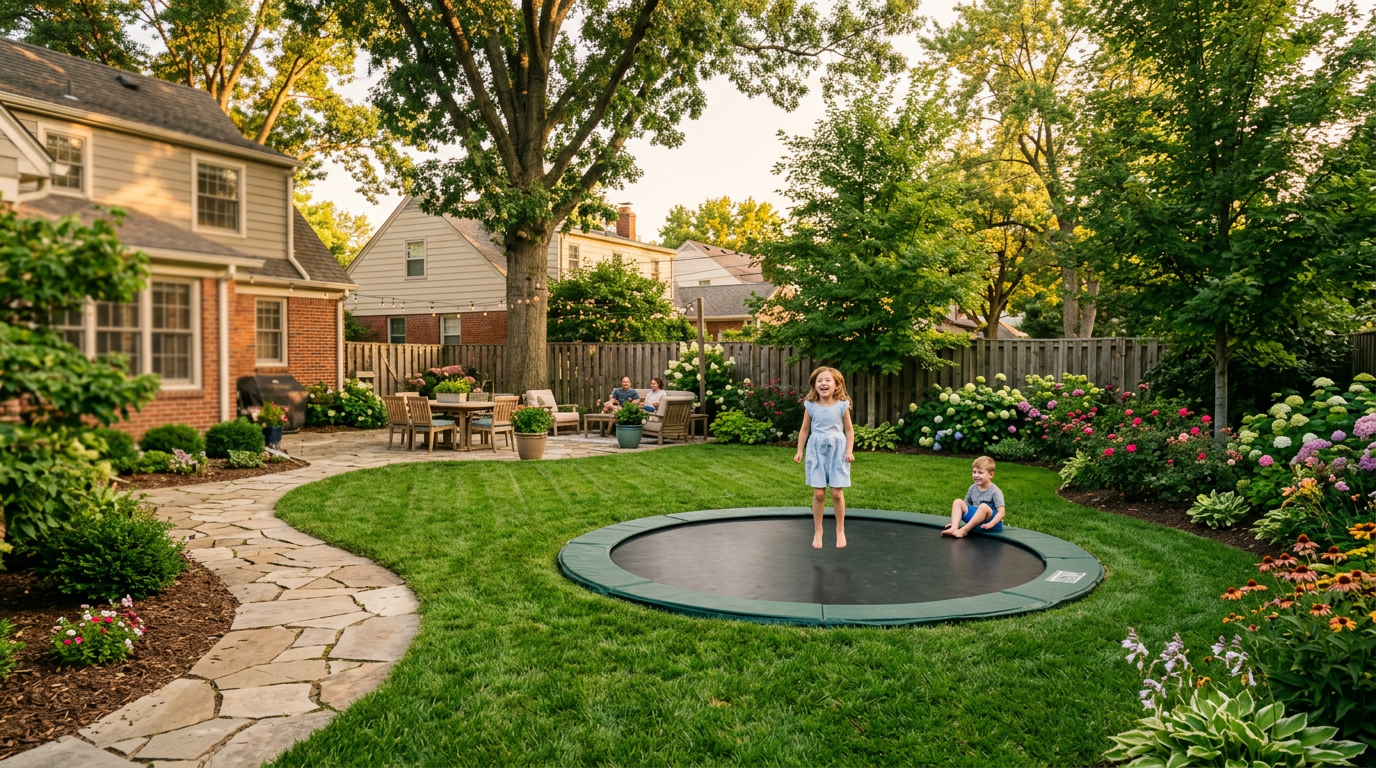
The biggest advantage of an in-ground trampoline is obvious the moment you see one installed: it eliminates the fall height. An above-ground trampoline puts the jumping surface 2 to 3 feet off the ground. Every exit is a drop. Every miss is a fall. An in-ground trampoline sits level with your lawn, so stepping on and off is as natural as walking across the yard.
The second advantage is visual. Above-ground trampolines are large, domineering structures — a black cage on steel legs that dominates whatever view it's in. An in-ground trampoline disappears into the landscape. The frame is below grade, the padding matches the grass, and from across the yard it reads as a design feature, not playground equipment.
Here's how the two compare head-to-head:
| Feature | In-Ground | Above-Ground |
|---|---|---|
| Safety | No fall height; step on and off at ground level | 2–3 ft fall from jumping surface to ground |
| Cost | Higher upfront (excavation + retaining wall + installation) | Lower upfront (self-assembly, no digging) |
| Yard integration | Flush with grass; nearly invisible from a distance | Large visible frame; dominates the landscape |
| Maintenance | Retaining wall and drainage need periodic checks; pit must stay clear | Frame and pads exposed; easier to inspect and replace parts |
| Weather durability | Retaining wall holds strong in wind; low profile reduces storm exposure | Can tip or shift in high winds; frame takes full force of storms |
| Visual appeal | Clean, low-profile; looks like a landscape feature | Industrial; hard to disguise or incorporate into landscaping |
Key takeaway: In-ground trampolines cost more and require excavation, but they eliminate the fall height and the eyesore — the two biggest complaints about traditional trampolines. If you're investing in your backyard long-term, the premium is worth it.
Round vs. Rectangular: Which Shape Fits Your Yard
Shape isn't just about aesthetics — it changes how the trampoline performs and where it fits in your yard. The right choice depends on who's jumping and how much space you have.
Round trampolines pull jumpers toward the center. The springs work equally in all directions, so the bounce naturally recenters you. That makes round the safer, more forgiving shape for families with young kids and casual jumpers. It's also the more compact footprint — a 12ft round trampoline fits in most suburban yards without dominating the space.
Rectangular trampolines deliver a more powerful, directional bounce. The springs along the long sides work harder than the short sides, which means a jumper can generate real height and control along the length. That's why rectangular is the choice for gymnasts, cheerleaders, and athletes who practice skills. The trade-off is footprint: a 14ft x 10ft rectangular trampoline needs a longer, more committed stretch of yard.

If your yard is wide and square, go round. If you have a longer, narrower space — or if someone in the household is serious about training — rectangular gives you more usable bounce surface and better performance for skills.
Sizing Guide: 8ft to 17ft
Size affects three things: how many people can jump at once, how much yard you need, and how much it costs. Here's a practical breakdown based on the sizes available from Berg and Capital Play:
| Size | Best for | Jumpers |
|---|---|---|
| 8ft round | Small yards, young kids (ages 4–8) | 1 at a time |
| 10ft round / 10x6 rect | Compact yards, kids and pre-teens | 1–2 |
| 12ft round | Standard suburban yard, family use | 2–3 |
| 14ft round / 14x10 rect | Larger yards, teens and adults | 2–3 |
| 16–17ft rect / 17ft oval | Large yards, athletes, serious training | 3–4 |

As a rule of thumb, measure your available yard space and subtract 3 feet on each side for safe clearance. A 12ft trampoline needs at least an 18ft x 18ft area. For a 14x10 rectangular, plan for at least 20ft x 16ft. Omaha lot sizes in neighborhoods like Elkhorn, Millard, and Gretna typically handle 12ft to 14ft round models comfortably. If you're on a smaller lot in central Omaha, the 8ft or 10ft options keep the yard functional.
Key takeaway: Don't oversize. A trampoline that fills your entire yard loses its appeal fast. Pick the smallest size that fits your jumpers — you can always go bigger, but you can't get yard space back.
Brand Comparison: Berg vs. Capital Play
Two brands dominate the premium in-ground trampoline market, and they take different approaches. Here's an honest breakdown to help you choose.
Berg is a Dutch manufacturer known for premium European engineering. Their in-ground line uses AirFlow jumping mats that allow 50% more air to pass through, delivering higher, smoother jumps. The TwinSpring Gold angled spring system creates a larger effective jumping area by positioning springs diagonally. Berg's FlatGround models — like the Ultim Champion 16ft — are engineered specifically for truly flush installation, with a patented silent frame profile that sits completely level with the ground. If you want the most refined bounce and the cleanest flush look, Berg is the premium choice.
Capital Play is a UK-based company that emphasizes safety standards and variety. Their in-ground line offers the widest range of sizes and shapes — round from 8ft to 14ft, rectangular from 10x6 to 17x10. Capital Play uses a DualTek double-strength galvanized steel frame (2mm thick, 42mm diameter) with a purpose-built retaining wall system included on every model. Their TDU patented vented safety pads eliminate pad slap noise by allowing air to escape through the pad rather than trapping it. If you want maximum size options and a retaining wall included, Capital Play covers more ground.
| Feature | Berg | Capital Play |
|---|---|---|
| Origin | Netherlands (European engineering) | United Kingdom |
| Mat technology | AirFlow (50% more air permeability) | Commercial-grade vented pads (TDU patented) |
| Spring system | TwinSpring Gold (angled, larger jump area) | Commercial-grade 8.5" springs (64–104 count) |
| Retaining wall | Included; FlatGround models designed for flush install | Included on every model (purpose-built system) |
| Sizes available | 11ft, 14ft, 16ft, 17ft (round + rectangular) | 8ft–14ft round; 10x6–17x10 rectangular |
| Weight capacity | Varies by model (up to 264+ lbs) | 220–264 lbs (varies by size) |
| Best for | Premium bounce quality, cleanest flush look | Maximum size/shape variety, retaining wall included |
Both are excellent brands that Omaha Sports & Games stands behind. The choice comes down to what matters most to you: Berg for the most refined bounce and cleanest installation, Capital Play for the widest range of sizes and a retaining wall on every model.
Shop In-Ground Trampolines
Now that you know the shape, size, and brand that fits your yard, here are the in-ground trampolines we carry. All are available with professional installation from Omaha Sports & Games.
Berg In-Ground Trampolines

Premium European engineering
Berg Champion In-Ground Trampoline
$1,869.00 $2,740.00
AirFlow jumping mat with 50% more air permeability. TwinSpring Gold angled springs for a larger jumping area. Available in 11ft, 14ft, and 17ft models.
View product
Top-tier FlatGround model
Berg Ultim Champion FlatGround 16ft In-Ground Trampoline
$2,430.00
16ft rectangular FlatGround with patented silent frame profile. AirFlow mat and TwinSpring Gold diagonal springs. The most refined flush installation Berg offers.
View productCapital Play Round In-Ground Trampolines

Capital Play Round 8ft In-Ground Trampoline
$1,665.00 $2,430.00
Compact 8ft round. DualTek frame, retaining wall included, 64 commercial springs. 220 lb capacity. Perfect for small yards and young kids.
View product
Capital Play Round 10ft In-Ground Trampoline
$1,875.00 $2,430.00
10ft round with 80 commercial springs and TDU vented pads. Retaining wall included. 220 lb capacity. Great for kids and pre-teens.
View product
Capital Play Round 12ft In-Ground Trampoline
$2,085.00 $2,430.00
12ft round with 96 commercial springs. The sweet spot for standard suburban yards. 264 lb capacity for family use.
View product
Capital Play Round 14ft In-Ground Trampoline
$2,185.00 $2,430.00
14ft round with 104 commercial springs. Largest round model. 264 lb capacity for teens and adults.
View productCapital Play Rectangular In-Ground Trampolines

Capital Play Rectangular 10ft x 6ft
$1,875.00 $2,430.00
10x6 rectangular for smaller yards. 68 commercial springs. 220 lb capacity. Compact footprint for kids.
View product
Capital Play Rectangular 14ft x 10ft
$2,395.00 $2,430.00
14x10 rectangular with 104 commercial springs. 264 lb capacity. Versatile size for all ages and yard types.
View product
Capital Play Rectangular 17ft x 10ft
$2,430.00
17x10 extra-large rectangular with 104 commercial springs. 264 lb capacity. Maximum bounce surface for athletes and large yards.
View productInstallation: What to Expect
Installing an in-ground trampoline is a bigger project than assembling an above-ground model, but it's a one-time job that pays off for years. Here's what's involved.
Excavation
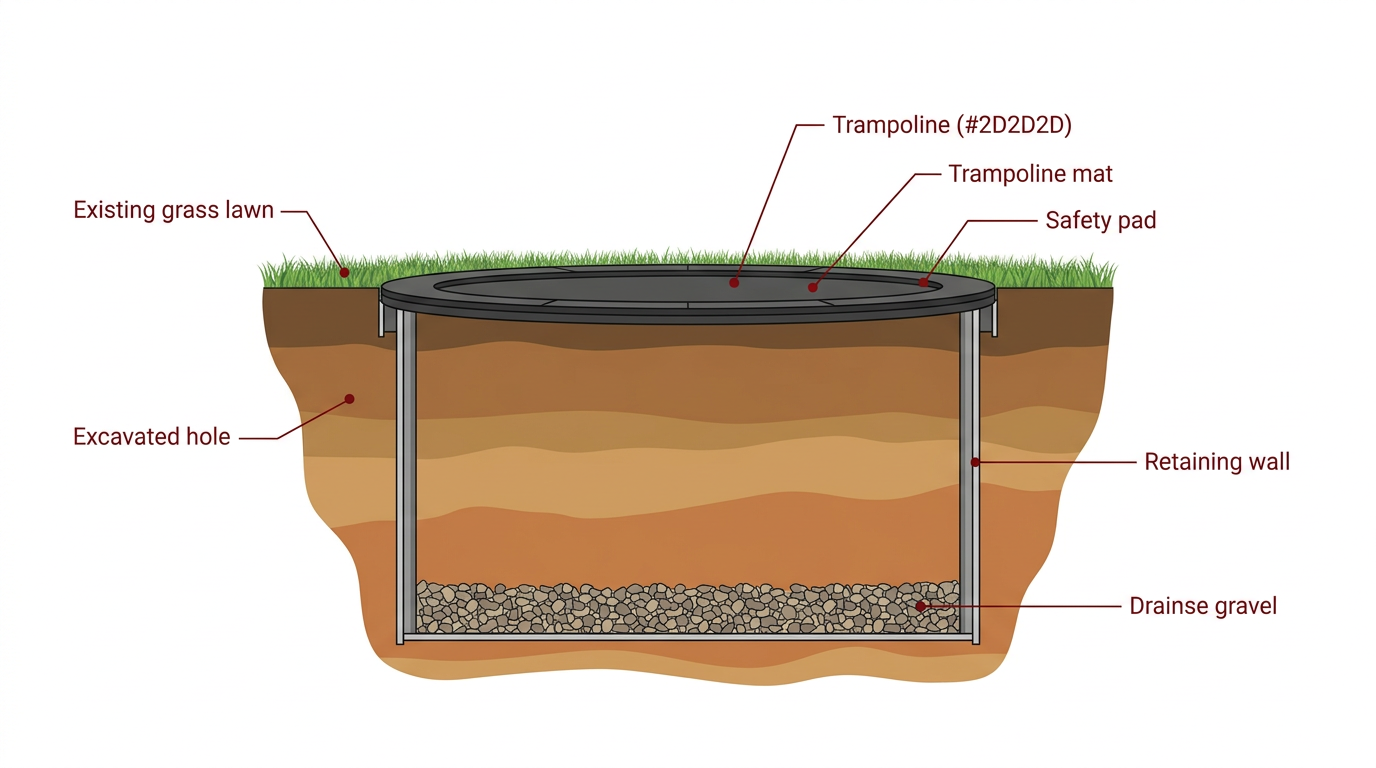
The hole needs to be roughly 30 inches deep and slightly wider than the trampoline frame. For a 12ft round trampoline, that means excavating a cylinder about 13ft across and 2.5ft deep — approximately 8 to 10 cubic yards of soil. In Omaha, where heavy clay soil is common, that clay holds its shape well during excavation but also means you'll need proper drainage to prevent water from pooling in the pit.
Retaining wall
The retaining wall is what keeps the hole from collapsing over time. Both Berg and Capital Play include purpose-built retaining wall systems designed specifically for their frames. The wall sits between the trampoline frame and the surrounding soil, holding back earth, roots, and water. Without a proper retaining wall, the pit will erode — especially in Nebraska's freeze-thaw cycle, where expanding ice pushes soil inward.
Drainage
Water management is critical. Without drainage, the pit becomes a pond after heavy rain. A layer of gravel at the bottom (6 to 8 inches) allows water to percolate into the subsoil. In areas with high clay content or a high water table — common in parts of Omaha and Sarpy County — a drainage pipe connected to a dry well or French drain may be necessary.
Nebraska climate considerations
Nebraska's freeze-thaw cycles are the biggest threat to an in-ground trampoline installation. When water in the soil freezes, it expands and pushes outward against the retaining wall. A properly installed wall with adequate drainage handles this without issue. But a DIY installation that skips drainage or uses an inadequate wall will see the pit narrowing and the frame shifting within a season or two.
Omaha's clay soil is actually an advantage for excavation — it holds its shape, so the hole stays clean during installation. But it's a disadvantage for drainage, because clay absorbs water slowly. That's why a gravel base and, in some cases, a drainage pipe are essential.
Professional installation from Omaha Sports & Games
Omaha Sports & Games offers professional in-ground trampoline installation starting at $5,500. That includes excavation, retaining wall installation, drainage setup, frame assembly, and final grading to ensure the trampoline sits perfectly flush with your lawn. Our team handles the soil, the drainage, and the Nebraska weather considerations so you don't have to.
Key takeaway: A proper installation with a retaining wall and drainage handles Nebraska's freeze-thaw cycles without issue. Skip either one, and the pit will erode within a season. Professional installation from $5,500 handles all of this.
Safety Features That Matter
Not all in-ground trampolines are built to the same standard. Here are the safety features that actually matter when you're comparing models.
Retaining wall quality: This is the most important structural component. A purpose-built steel retaining wall — like Capital Play's DualTek system or Berg's FlatGround frame — holds the soil back permanently. A makeshift wall from landscape timbers or plastic edging will fail. Look for galvanized steel, 2mm thickness or better, and a system designed specifically for the trampoline model.
Padding thickness and coverage: The safety pad covers the springs and frame edge. Berg uses extra-thick PVC padding (0.55mm on the Ultim Champion). Capital Play uses TDU patented vented pads that eliminate pad slap — the annoying, potentially startling noise of pads slapping the mat on every bounce. Thicker, wider padding means better coverage and fewer exposed edges.
Spring design: Berg's TwinSpring Gold springs are angled diagonally, which increases the effective jumping area and creates a smoother, more controlled bounce. Capital Play uses straight commercial-grade 8.5" springs (up to 104 on larger models) for maximum power. Both approaches are safe; the difference is feel — Berg is smoother, Capital Play is punchier.
Weight ratings: Capital Play rates their 8ft and 10ft models at 220 lbs, and their 12ft, 14ft, and rectangular models at 264 lbs. These are real structural limits, not marketing numbers. Stay within them, especially with multiple jumpers.
UV-resistant materials: Nebraska summers deliver intense UV exposure. Look for UV-treated jumping mats, PVC padding, and galvanized or powder-coated steel frames. Both Berg and Capital Play use UV-resistant materials across their in-ground lines — this is not a place to cut corners, as sun damage degrades mat elasticity and pad integrity over time.
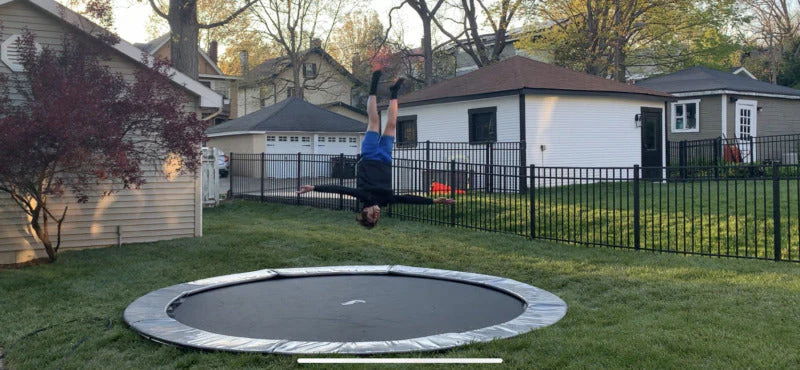
Weather durability for Nebraska: The low profile of an in-ground trampoline is itself a safety advantage in storms. Where an above-ground trampoline acts like a sail in high winds — and we've all seen them blown across Omaha yards after a summer thunderstorm — an in-ground model has almost no wind exposure. The retaining wall and below-grade frame mean the trampoline stays put in conditions that would send an above-ground model into the neighbor's yard.
In-Ground Trampoline Buying Guide: Frequently Asked Questions
Can I install an in-ground trampoline myself?
Technically yes, but it's a significant project. You'll need to excavate a hole 2.5 feet deep and wider than the trampoline, install a retaining wall, set up drainage, and assemble the frame perfectly level with the ground. Most homeowners in Omaha hire professional installation because the excavation requires equipment and the drainage setup is critical in our clay soil. Professional installation from Omaha Sports & Games starts at $5,500.
How deep does the hole need to be?
Typically 30 inches (2.5 feet) deep, and slightly wider than the trampoline frame. The exact depth depends on the model — Berg FlatGround and Capital Play in-ground kits have specific depth requirements in their installation guides. The hole must be deep enough that the frame and springs sit below grade, with the jumping mat level with the surrounding grass.
Do in-ground trampolines work in cold climates like Nebraska?
Yes, when properly installed. The key is a steel retaining wall and adequate drainage. Nebraska's freeze-thaw cycles put pressure on the pit walls as moisture in the soil freezes and expands. A galvanized steel retaining wall handles this without issue. Without one, the pit will narrow over winter. Both Berg and Capital Play include retaining wall systems designed for this exact challenge.
How much does professional installation cost?
Professional in-ground trampoline installation from Omaha Sports & Games starts at $5,500. This includes excavation, retaining wall installation, drainage setup, frame assembly, and final grading. The final cost depends on your yard's soil type, accessibility for excavation equipment, and drainage requirements.
What size trampoline do I need for my yard?
Measure your available space and subtract 3 feet on each side for clearance. A 12ft round trampoline needs at least 18ft x 18ft. A 14x10 rectangular needs about 20ft x 16ft. For small Omaha yards, an 8ft or 10ft model keeps the space functional. For larger yards in Elkhorn or Gretna, 14ft to 17ft models make the most of the space.
Are in-ground trampolines safer than above-ground?
Yes, primarily because they eliminate the fall height. An above-ground trampoline puts the jumping surface 2 to 3 feet off the ground — every exit is a drop. An in-ground trampoline sits level with the lawn, so stepping on and off is like walking across the yard. The low profile also eliminates wind exposure, which is a real safety issue during Nebraska thunderstorms.
Ready to Transform Your Backyard?
An in-ground trampoline is a one-time investment that changes how your family uses your yard. No cage, no ladder, no eyesore — just a clean, flush surface that's ready to jump on. The right model comes down to your yard size, who's jumping, and whether you value Berg's refined bounce or Capital Play's size variety.
Two ways to get started:
1. Shop in-ground trampolines — Browse our full collection of Berg and Capital Play in-ground trampolines. Every model is available with professional installation.
Shop all in-ground trampolines2. Request a free installation quote — Not sure which model fits your yard? Want professional installation? Contact our team for a free quote. We'll help you choose the right size, assess your yard's soil and drainage, and handle the full installation — starting at $5,500.
Request a free quoteStop by our showroom in Elkhorn, Nebraska to see in-ground trampolines in person, or browse the full collection online. Our team knows the products, the soil, and the weather — and we'll make sure your installation is done right the first time.